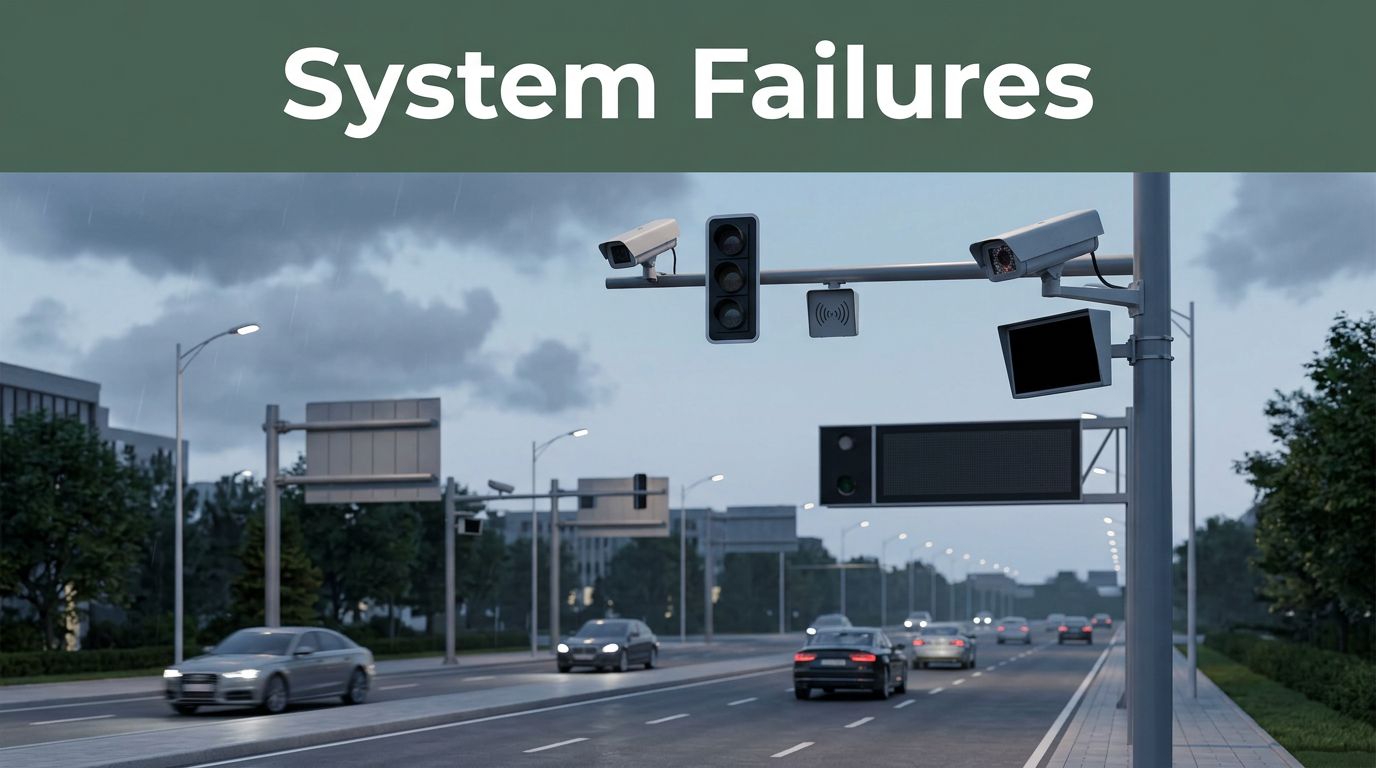
You ever watch your commute go from normal to stalled, then think, “Why didn’t anyone see this coming?” One week, a city can be tracking speed and crashes smoothly, then a storm hits, cameras go dark, and the data turns into guesswork.
Traffic monitoring systems use cameras, sensors, and radars to track how fast vehicles move, where congestion forms, and when incidents happen. In 2026, cities use that info for three big jobs: safety alerts, traffic signal timing, and enforcement. When the system works, it feels invisible. When it fails, everything slows down (sometimes literally).
Still, the same types of failures show up again and again. Hardware breaks or loses accuracy. Software updates cause outages or bad reads. Data turns wrong, which leads to wrong decisions. Integrating tools across vendors and control rooms can be messy. Maintenance gets delayed, and staffing gaps make it harder to recover quickly. Finally, cyber threats and scale limits can stall operations when you need them most.
Let’s break down the most common problems in traffic monitoring systems, including real examples from US cities and what similar issues look like in other places, like India. Once you know the failure pattern, it’s easier to spot weak points and push for fixes that actually hold up.
Hardware Breakdowns Leaving Roads Without Eyes
Traffic monitoring hardware is the “eyes and ears” of the network. When it fails, the system can’t observe the road. And without observation, even smart analytics turn into educated guesses.
A common theme is exposure. Sensors sit outdoors. Cameras hang in rain and heat. Radars face fog, dust, and vibration. Over time, wear builds up. Then one heavy weather event or a power glitch knocks parts offline.
Think of it like a phone screen in a downpour. It still looks fine, but it stops responding. On the road, “not responding” can mean no speed readings, no vehicle counts, or missed crash alerts.
In the US, outages from physical issues happen more often than people expect. For example, a faulty cable knocked out multiple traffic signals in downtown Cleveland, and power stayed out for hours before full restoration. Drivers had to treat intersections as four-way stops, which increases risk and slows flows. You can see an example of how one cable can cause widespread impact in downtown Cleveland traffic signals outage.
In other places, winter conditions can cause repeated failures. Gothamist reported that rough winter left many NYC traffic signals “on the fritz,” showing how weather can compound mechanical stress across an asset fleet. When signals and monitoring cameras are both stressed, congestion worsens fast. See Rough winter leaves many NYC traffic signals on the fritz.
Weather and Wear Taking a Toll on Sensors
Weather does more than reduce visibility. It changes sensor performance in ways that are easy to miss during routine checks.
Heavy rain can blur camera views and scatter light. Dust in busy corridors can clog lenses and degrade image clarity. Extreme heat or cold shortens component life, especially for enclosures and moving mounts. Snow can cover gear and block detection. Pollution can leave residue on optics, which then increases error rates.
Meanwhile, fog and steam can confuse radar. Even when the equipment is “online,” the readings may drift. A system can report data that looks normal at first glance, but it’s less reliable in the exact conditions you care about, like night rain or foggy mornings.
One subtle issue is camera tilt and mounting shift. A small change can alter where the system “sees” the lane. That affects speed measurements and vehicle counts. In practice, you often only learn about this after incidents, complaints, or mismatched reports from field teams.
Wear also includes the boring parts. Cable insulation cracks. Connectors loosen. Fans and filters fail in warm enclosures. Small failures create big blind spots when multiple devices miss the same time window.
Cities can reduce these risks with better housing, stronger cable runs, and clear inspection schedules. However, the problem itself still shows up because hardware lives outside, not in a lab.
Power and Connection Failures in Tough Conditions
Power failures can cripple a traffic monitoring network in minutes. Storms, flooding, and grid instability can cut power to cabinets, camera poles, and edge units. When power goes out, the monitoring system stops observing.
But connection failures can be just as damaging. Loose cables from vibration, water intrusion in junction boxes, or corrosion on connectors can cause intermittent data drops. In those moments, the system may report “no data” or worse, stale data that looks current.
Night-vision and infrared components also have stress points. When they degrade, they don’t always fail completely. Instead, they can produce lower contrast images, which increases misreads.
A key operational headache is recovery time. If the system relies on a vendor for replacement hardware, delays can stretch into days. If the field team is short-staffed, diagnosis can take longer. Either way, the city loses time during peak commute periods.
The most frustrating part is the blind spot often lines up with the worst conditions. Storms and high crash risk happen together, so monitoring loss hits right when safety needs it most.
Software Bugs Throwing Traffic Data Into Chaos
Even with good hardware, traffic monitoring can still fail due to software issues. Updates can break old integrations. Code can crash. Data pipelines can stall. And error handling might not cover every roadside scenario.
If you’ve ever watched an app freeze after a “minor update,” you already understand the vibe. Traffic software is just harder to roll back. It connects to signal controllers, cameras, plate readers, and map systems.
In 2026, many cities also add edge processing, where more work runs near the camera. That helps reduce bandwidth costs. However, it adds new components and new failure points.
When software breaks, the problems can look inconsistent. You might see sudden drops in vehicle counts. Or speeds might jump for a few hours, then normalize. Sometimes the system still shows data on dashboards, but the numbers are wrong due to a time sync issue.
In short, software bugs can turn “real-time” into “real-ish.”
Updates and Integrations Gone Wrong
Traffic monitoring systems rarely live alone. They connect to signal timing platforms, incident management tools, and sometimes enforcement workflows.
When a city updates one part of the stack, compatibility gaps can appear. A legacy feed might stop matching a new camera naming scheme. A timestamp format can change. A map layer might shift coordinate systems. Then analytics start attaching events to the wrong location.
These integration failures often show up after maintenance windows. The system looks fine during testing, then fails under real traffic patterns. That’s because testing usually uses controlled conditions, not crowded lanes in rain.
In addition, different vendors may update at different speeds. Standards progress, but legacy setups don’t magically upgrade. If one component lags behind, the “whole network” still suffers.
The outcome is simple: the city makes decisions based on incomplete or mismatched data.
Edge Computing Adding New Glitches
Edge computing moves processing closer to the cameras. Many cities do this to reduce costs and speed up alerts. For example, some setups run object detection on-device instead of sending all video to a central server.
However, edge units add new software, new dependencies, and more configuration. The same camera can behave differently across devices due to version differences. Models and preprocessing can drift if updates aren’t carefully managed.
Edge deployments also need stable storage. If an edge node fills up its buffer during a network hiccup, it might drop frames or delay results. That can affect incident detection, especially for short-lived events like lane blockages.
So even when the main platform stays up, edge issues can still break “real-time” monitoring.
Inaccurate Data Leading to Wrong Decisions
Data accuracy is where traffic monitoring stops being an IT project and becomes a public safety issue. When readings are wrong, the city acts on the wrong story.
If traffic volume is overestimated, signal timings may create unnecessary waits. If speed is underestimated, congestion predictions can trigger alerts too late or too early. If plate reads are wrong, enforcement actions can become a legal and trust problem.
Errors often come from conditions that stress sensors. Night lighting, glare, rain droplets, and wet road reflections can all reduce detection quality. Some systems struggle to separate vehicle types accurately, like bikes versus cars.
Also, road geometry matters. A lane marking that looks clear in daylight can vanish at night. A camera angle that works for one intersection can fail at another because of slopes, curvature, or occlusions from buses and trucks.
If you want one research-driven way to think about this, consider work on detecting traffic sensor malfunctions using lane-to-lane correlation. Studies like this show that sensor accuracy issues can be identified by inconsistencies across adjacent lanes, rather than trusting a single device reading. See detecting traffic sensor malfunctions using lane correlation.
That’s a reminder: accuracy issues aren’t always obvious on dashboards.
Camera and Sensor Misreads in Real Life
In real conditions, misreads show up in predictable ways.
Cameras can confuse shadows for vehicles. Reflections can create false objects. Poor contrast can reduce confidence in detection. Bad weather can reduce clarity just enough to cause miscounts.
Sensors can also miscount. Inductive loops might misread a lane if traffic composition changes. Radar can struggle with multipath reflections in areas with many buildings. And occlusions happen constantly. A bus can block a view. A delivery truck can hide smaller vehicles.
Even a well-calibrated system can drift. Mounting shifts, vibration, and enclosure changes can alter how the system maps pixels to real-world distances.
AI Models Not Adapting Well
Many modern systems use AI for detection and tracking. That helps, but it doesn’t remove the need for local tuning.
Models trained in one city or neighborhood may fail in another. Road markings can differ. Vehicle types and driving behavior can differ. Lighting varies by season and infrastructure. If the model doesn’t adapt, error rates rise.
Also, edge cases matter. A model might handle typical sedans well but struggle with motorcycles in rain. Or it might work on open roads but fail at intersections with heavy turning movements.
When AI doesn’t adapt, you get a pattern of “looks fine until it doesn’t.” Then the data becomes less trustworthy exactly when officials need it most, during incidents and unusual traffic patterns.
Integration, Maintenance, and Bigger Threats Slowing Progress
Even when each component works, traffic monitoring can still underperform due to system-level problems. Integration gaps are common. Maintenance delays are common too. And cyber risks are now part of the conversation, not an afterthought.
In practice, cities often stitch together tools over years. Older cameras feed into newer analytics platforms. New units might use different data formats. Some dashboards depend on manual checks. Others rely on a single data pipeline that can break silently.
That fragility becomes a bigger issue when staff shortages show up. If the team that monitors the monitors is understaffed, problems linger longer.
A federal view of the broader challenge appears in DOT’s FY2026 top management challenges, which include recurring themes around safety, risk, and management capacity. It’s a useful reminder that monitoring systems still compete with budget and operational constraints. Read DOT’s FY2026 top management challenges.
Why Systems Refuse to Talk to Each Other
Interoperability problems start with naming and location mapping.
One vendor labels a camera as “Pole A, Eastbound 1.” Another labels it by a coordinate grid. A third exports events with a different time zone setting. If these don’t match, the system can’t join data correctly.
Also, cities may run multiple monitoring networks that never fully connect. One center handles incidents. Another handles enforcement. A third handles signal optimization. Even when the cameras are the same, data may not flow end-to-end.
On top of that, standards evolve. V2X and other roadside data formats improve over time. But legacy deployments can’t update quickly. Then officials get partial visibility.
The result is a split picture, where each dashboard shows something different. That makes decisions harder during fast-moving incidents.
Maintenance Delays and Budget Crunch
Maintenance is where good plans often meet reality.
After storms, broken hardware may sit waiting for parts. Repairs can take weeks if cables, mounts, or edge units must be shipped. If responsibilities are unclear between city staff and vendor teams, diagnosis slows down.
Budget constraints also push cities toward fewer replacement cycles. That means devices run longer past their ideal service life. You might delay replacements for “just a few more months.” Then one failure triggers a bigger outage.
Staffing gaps matter, too. If fewer technicians are available for routine checks, calibration and cleaning happen less often. That increases error rates and reduces confidence in alerts.
Even a well-designed monitoring system can’t beat slow recovery. The road needs visibility when traffic is unpredictable.
Cyber Risks and Scaling Nightmares
Traffic monitoring systems connect to networks. Cameras feed servers. Controllers receive commands. Edge units run software that also needs updates.
That connectivity creates attack surfaces. A compromised camera might leak data. A compromised network segment might disrupt monitoring. A denial-of-service attack could block alerts when you need them most.
Scalability adds another risk. Video data is heavy. If the central systems can’t scale, they can fall behind during busy events. Then incident detection becomes delayed.
Federal guidance emphasizes cybersecurity planning for highway systems. FHWA’s Transportation Cybersecurity Strategic Plan lays out a roadmap mindset for protecting critical assets from cyber incidents. It also reinforces a key point: protection requires more than installing antivirus.
Cities need governance, monitoring, patch processes, and incident response plans. Without that, networks age into risk.
And if cyber risk wasn’t enough, scalability pressure keeps rising as video counts and data demands grow.
2026 Trends Pointing to Fixes Ahead
Despite all these problems, 2026 shows real movement toward fewer blind spots and faster recovery.
First, better sensor housings and mounting practices help resist weather damage. Cities are learning that “it lasted one summer” doesn’t mean it will survive the next storm season. Better protection, plus more consistent inspections, reduces sudden offline events.
Second, calibration and validation are getting more attention. Some teams now test accuracy after maintenance, not just before deployment. That matters because small shifts can create big speed and count errors.
Third, edge processing continues to grow, but with stronger software discipline. Cities are pushing for version control, rollback plans, and clear monitoring of edge nodes. When updates break something, fast rollback can save the day.
Finally, privacy rules are becoming part of system design. That’s not just a legal issue. It forces teams to rethink data retention, access controls, and who can view raw video.
There’s also a broader lesson from vehicle sensing and onboard systems. Reliable decisions depend on consistent data, correct timing, and continuous validation. Traffic monitoring works the same way.
So yes, traffic monitoring systems still break. However, the fixes in 2026 focus on the core causes: physical resilience, software reliability, accurate data, better integration, and stronger security.
Conclusion: Traffic Monitoring Works When Every Weak Link Is Covered
Traffic monitoring systems fail in patterns. Hardware breaks, software glitches, data gets wrong, and integrations drift out of sync. Then maintenance delays and cyber risks turn small issues into bigger outages.
The strongest takeaway is simple: reliability isn’t one feature. It’s a chain of dependable hardware, tested software, accurate data, and connected workflows.
If your city relies on traffic monitoring for safety and signal control, push for hardening at every link. Ask what happens during storms, how quickly devices are repaired, and how data accuracy is validated. Support funding and accountability for the parts that keep the system trusted when conditions get messy.
Because that original commute problem, the one you felt in your gut, never starts with “mystery traffic.” It starts with missing or unreliable monitoring. And in 2026, understanding those weak links gives cities a real path to smoother, safer roads.