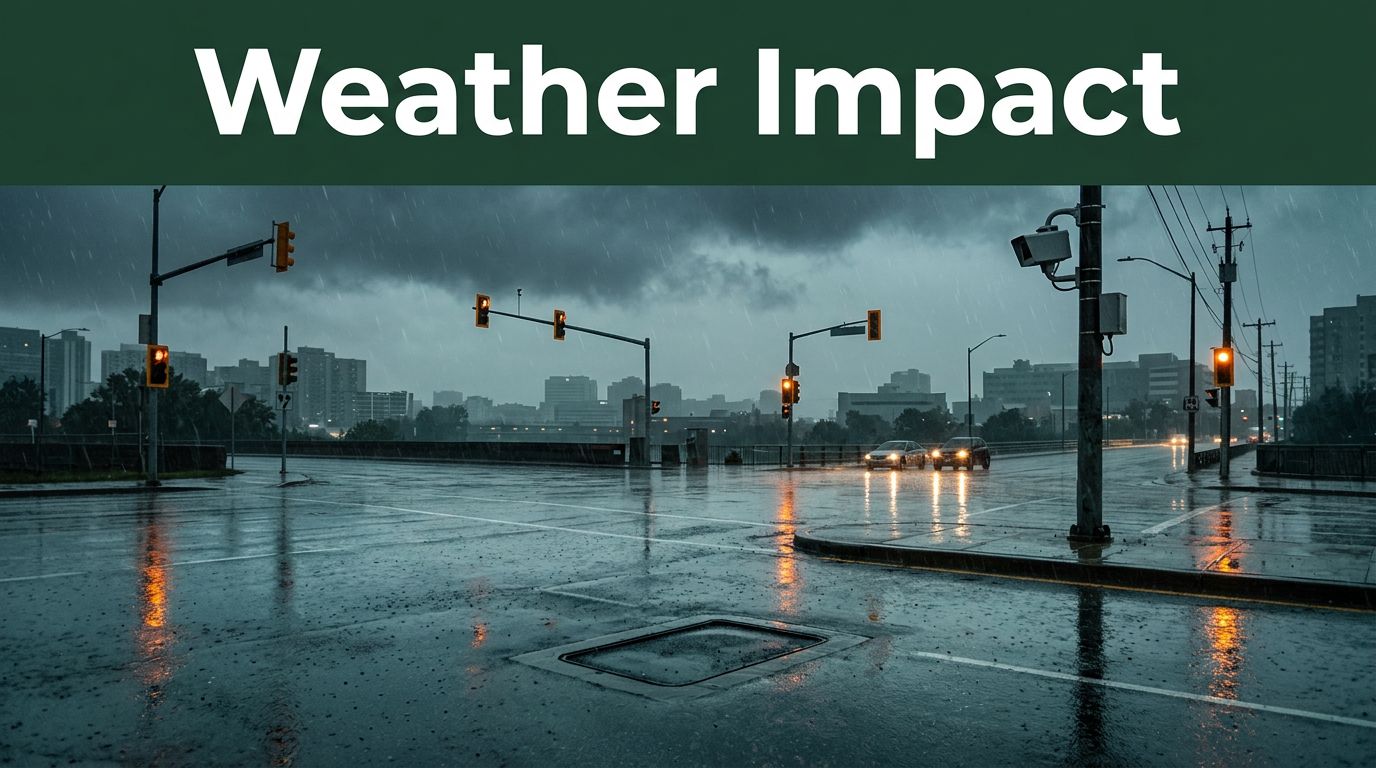
A rainy rush hour can turn traffic control into a guessing game. When traffic sensors get fooled by weather, lights may hold green too long, switch too late, or skip calls for vehicles. That can mean backups, slower commutes, and more near-misses at intersections.
Most sensors do their job well on clear days. Still, storms bring rain, snow, fog, ice, heat, and grime. Those factors can change how well detectors “see” cars, count vehicles, or measure speed.
So, how exactly does weather affect traffic sensors? Below you’ll see the most common failure modes for inductive loops, cameras, radar, and LiDAR, plus the niche cases like acoustic sensing. You’ll also get practical fixes that agencies use to keep signals working during bad weather.
Inductive Loop Detectors: Tough Underground Warriors Against Most Weather
Inductive loops sit under the pavement, usually in a saw-cut slot, then sealed and wired down to a detector unit. Because the sensing area lives below the road surface, rain and snow don’t hit the wire directly. In plain terms, a car changes the loop’s magnetic field, so the system knows a vehicle is present.
However, “underground” does not mean “weather-proof.” The real enemy is what weather does to the road over time. In winter, moisture seeps into tiny cracks. Then freeze-thaw cycles expand that water. Over repeated cycles, pavement can heave, the slot seal can fail, and the loop wiring can get stressed.
For agencies looking for background on how loops are used in real signal systems, see Chapter 2. Inductive Loop Detectors. It helps connect loop design to how agencies collect reliable traffic counts.
Another risk comes from maintenance. Repaving or lane work can cut too deep, nick cables, or disturb the loop placement. After repairs, detectors may still work, but the detection zone can shift slightly. That’s when you see weird patterns like vehicles “not being seen” near the stop line.
Heat also matters, but in a slower way. On long hot stretches, asphalt softens and can relax. Over time, that can change how the loop sits in the slot, even if the loop never gets wet. Wind and fog usually matter far less for loops than for cameras.
Think of inductive loops like a buried treasure. Surface weather can rage nearby, but the treasure stays under cover, unless the road above it cracks and shifts.
Freeze-Thaw Cycles: The Silent Road Crackers
Freeze-thaw damage is the classic loop problem story. Water expands as it freezes. That expansion pushes on cracks, sealant edges, and the pavement around the loop cut.
When pavement heaves, the loop can experience strain. Sometimes it stays electrically fine, but the loop geometry changes. Other times, the conductor insulation gets worn, which can cause intermittent detection.
Many maintenance teams end up replacing loops after harsh winters because troubleshooting can take time. One reason is that a failing loop can mimic other issues, like bad detector cards or wiring faults. For a readable breakdown of how loop detection works and why loops fail, check How Vehicle Detection Loops Work and Why They Fail.
Mitigations include deeper installations, better sealing, and routes that minimize freeze-thaw exposure. Some agencies also place loops in locations that plows can clear more safely, rather than where blades scrape the pavement edge.
A simple goal helps: keep water out of the cracks around the loop.
Heat’s Slow Wear on Pavement and Wires
Extreme heat acts like a slow loosener. Asphalt can soften, and road surfaces can flex more with traffic loads. That flex can slowly change how the loop behaves in the slot.
Short-term, detectors often still work. But over months and years, the pavement can settle. If the loop shifts even a little, the detector’s tuned sensitivity might need adjustment.
Also, hot conditions can increase maintenance visits. Crews may open pavement for repairs more often in warm seasons. During those jobs, cable bundles can get pulled, splices can get stressed, and the loop’s placement can change.
The pattern is usually subtle. First you see “late calls” at signals. Then you see detection dropouts near certain lanes. In the worst cases, detectors fail completely and the intersection runs on fallback timing.
Video Cameras: Blinded by Raindrops, Snow, and Ice Buildup
Cameras are a popular option because they can “watch” multiple lanes. Most systems use pole-mounted cameras and image processing to detect vehicles. When conditions are right, they track traffic movement without cutting pavement.
Weather changes that quickly. Rain droplets scatter light and create glare. Snow can build up on housings and lenses. Ice can form a thin sheet that blocks the view, or it can create bright reflections that confuse the software.
If you’ve ever tried to read a screen through a dirty windshield, you already get the idea. Camera detection is similar. The view quality drops first, then the counts and calls can drift.
On top of that, cameras hate fog. Fog reduces contrast, so the algorithm struggles to separate vehicles from the background. Wind can also shake mounts slightly. Even small shakes can blur edges and cause false detections.
Meanwhile, heating systems inside camera cabinets can fail or run too hot. When heat and cold cycle repeatedly, seals age faster. Then moisture can find its way inside.
A lot of agencies manage this by using camera backups. For instance, many systems can fall back to other detection types if the camera view turns unreliable. That matters because a wrong light cycle affects safety.
For a practical way to see weather with traffic cameras in real time, look at agency-run feeds like Vermont’s RWIS Camera. It shows how weather stations combine visuals with road monitoring.
Snow and Ice Storms: Real Chaos from Covered Lenses
During winter storms, the biggest camera issue is simple: the lens gets blocked.
Heavy snow can bury a camera view entirely. Even partial coverage can hide the stop line or lane markings. When that happens, the system might “see” fewer vehicles than are actually there.
Ice is sneakier. A clear ice layer can look thin, but it can distort reflections and smear highlights. It can also make the camera focus drift, especially after refreezing cycles.
In late January 2026, a major storm hit parts of the eastern US with freezing rain and heavy snow. Freezing rain created dangerous ice layers on roads, and power outages also disrupted signal operations. Even if a camera stays powered, the view can still get coated. Then you get wrong detections just when drivers need consistent timing the most.
The fix is often hands-on: crews chip ice, wipe lenses, and check alignment. Some locations also use heated housings or lens heaters so ice forms less often. Wipers can help for certain mount styles, but they still need service.
Fog, Heat, and Wind: Sneaky Visibility Killers
Fog acts like a contrast killer. Vehicles blend into the background because edges get soft. As a result, the camera might miss vehicles, or it might detect “blobs” where no vehicle exists.
Heat adds another twist. In hot weather, housings can overheat. That can fog the inside of the glass (from condensation patterns) or change internal air flow. Also, thermal expansion can shift the lens slightly.
Wind can make everything worse because cameras need stable framing. Gusts can shake a pole mount. Then the software sees motion in the scene and may misread it as vehicle movement.
This is where good system design matters. If the camera goes bad, the signal controller should not freeze. It should switch to a backup detection path, or run safe timing plans.
In many deployments, you’ll see multiple sensor types working together. That brings more stability during weird weather patterns.
Radar Sensors: Punching Through Rain and Fog with Radio Waves
Radar detects vehicles using radio waves. In many setups, the radar sits at the roadside and estimates presence, speed, or lane occupancy. Unlike cameras, radar does not rely on visible light.
That’s why radar often handles rain and fog better. Rain droplets do scatter signals, but radar can still track reflections from vehicles. In short, radar still sees “something,” even when visibility drops.
However, heavy precipitation brings problems too. Rain and wet snow can create clutter. Some drops reflect radar energy and show up as small targets. The software then has to filter those targets out.
Cold weather usually works fine as long as the unit stays sealed. Ice on the outer cover can block or distort the wave path. Wind can also shake mounts, which can affect alignment.
If you’re trying to compare detection choices for winter conditions, the real-world tradeoffs show up clearly in Which Detection Technology Works Best in Snow and Fog?. It’s a useful reference for how agencies think about performance under harsh visibility.
Also, modern deployments often pair radar with other sensors. That improves reliability when weather creates odd patterns for one sensor type.
Heavy Rain and Snow Clutter Challenges
In heavy rain, each drop can act like a tiny reflector. When the radar gets hit by thousands of those reflectors, it’s like listening to many faint voices at once.
The result can be false detections, short bursts of “presence,” or speed glitches. Wet snow can create similar clutter, especially if it sticks to the radome.
Software helps. Tuned filtering can reduce false targets. Some radar systems use tracking logic, so they expect real vehicles to move in realistic paths. If a reflection changes too erratically, the software can ignore it.
Mount quality also matters. A sturdy installation reduces shake and keeps the detection zone aligned with lanes.
Finally, heating elements and radome designs can prevent ice buildup. When ice forms, radar waves may reflect differently than the system expects.
Radar often stays usable through storms. It just needs the right settings and good maintenance.
LiDAR Lasers: Scattered and Fouled by Precip and Dust
LiDAR measures distance by sending out laser pulses and timing their return. This makes it great for building 3D point clouds. Many traffic and mobility systems use LiDAR to map lanes, detect objects, or support advanced traffic operations.
Weather can still interfere. Rain scatters laser beams, so fewer pulses return cleanly. Fog does the same, because tiny droplets scatter light in all directions.
Snow is a bigger issue than most people expect. Snowflakes can partially block the beam and also create confusing returns. Even when the LiDAR is “working,” the point cloud can get sparse or noisy. Then the tracking software may struggle to form stable objects.
Dust and grime matter too. Roadside sensors collect particles from air and traffic. Wind can blow debris across the optical window, which reduces returns over time.
Heat cycles can also impact performance. Some systems throttle power under certain thermal conditions. If throttling is active, range and update rates can drop.
For an explanation of how weather changes LiDAR behavior, see How Weather Really Affects LiDAR Performance. It provides a clear overview without getting stuck in jargon.
Finally, there’s a broader research trend toward “precipitation-aware” sensing. For example, Scientific Reports describes modeling that accounts for adverse weather effects on sensor performance. You can find the study titled Precipitation-aware sensor ecosystem modelling.
The take-home idea is simple: LiDAR is precise, but conditions can break precision.
Fog and Snow: Massive Range Drops in Tests
When fog thickens, LiDAR range can fall quickly. Instead of clear returns from solid vehicle surfaces, the sensor gets scattered light from droplets. That can overwhelm the signal, or make it too noisy to trust.
Snow adds its own chaos. Falling flakes can create extra returns in front of the sensor. Meanwhile, accumulated snow on the window can block direct beams. In both cases, point clouds can show “ghost shapes,” or they may miss the target entirely.
In test-like situations, the difference is not small. Systems can go from useful detection to weak detection fast. That’s why LiDAR deployments often include strong cleaning and heating strategies.
In real traffic use, that means you shouldn’t assume the sensor will always behave like it does on a clear day.
Self-Cleaning Tech for Autonomous Vehicles
Many modern LiDAR setups rely on cleaning systems. Heated windows reduce ice formation. Wipers or air jets clear light buildup.
Some systems also use multi-sensor fusion. That means radar may handle presence and speed when LiDAR point clouds degrade. Then the system combines inputs for a more stable output.
In practice, fusion helps because each sensor fails in different ways. LiDAR can lose range in fog. Radar may still find vehicles. Cameras may struggle in glare, but radar can still track motion.
The best “fix” is not one magic device. It’s a system design that expects bad weather.
Acoustic Sensors and Extreme Conditions: Niche but Noisy Troubles
Acoustic detection is less common for traffic signals, but it shows up in some warning and safety contexts. The basic idea is to use sound patterns from vehicles, then match them to detection cues.
Weather can still disrupt acoustic sensing. Wind and precipitation can add background noise. That noise masks vehicle sounds, especially at lower speeds.
Cold changes how sound travels. That can affect timing and detection thresholds. Heat can also shift conditions slightly, but the bigger issues usually come from wind and noisy weather.
Acoustic systems also struggle in fog if the vehicle sounds are quiet and the environment stays calm. Then the algorithm has fewer clear signals to classify.
Because of these limits, acoustic sensing typically works best as a supporting sensor, not the sole detector.
Smart Solutions Keeping Sensors Sharp in Any Storm
Agencies can do more than swap broken parts. Many improvements focus on three themes: protect the optics and housings, tune the software for precipitation, and build redundancy so one sensor failing does not stop traffic control.
Across sensor types, heated housings and radomes help prevent ice and reduce condensation. Wipers and air jets keep camera and LiDAR windows clear longer.
Then there’s fusion logic. When radar, cameras, and LiDAR work together, the system can compare results. If one sensor drops off, the controller can trust the others more heavily.
Some deployments also use weather-aware timing plans. For example, when a storm hits, signals may switch to safer cycle patterns. That reduces the risk of strange green timing based on unreliable detections.
You’ll also see an increasing focus on hardware ratings, like wind-resistant mounting and seals that handle freeze-thaw wear. Portable, solar-powered traffic units now often include wide operating temperature ranges and wind-safe designs.
A practical example is how North America deployments handle temporary signals and work zones. Portable units often use weather-rated housings and sensor redundancy because lane conditions change fast. When you pair that with good maintenance schedules, sensor performance stays more consistent.
The strongest weather fix is redundancy. If one sensor gets blinded, another can still guide safe signal timing.
One more trend is smarter fault detection. Systems can flag when a sensor view looks wrong or when outputs become unstable. That helps crews respond faster, before a small issue turns into full detection failure.
If you’re trying to plan for storms, focus less on “perfect detection” and more on “safe detection.” Weather will always win sometimes. The goal is to keep traffic control reliable anyway.
Conclusion: Weather Tests Sensors, But It Doesn’t Have to Break Traffic
If you remember one thing, remember this: weather affects traffic sensors in different ways. Cameras often get hit first by visibility problems. Inductive loops stay strong because they’re buried, but freeze-thaw and pavement damage can still ruin them. Radar can keep working through rain and fog, while LiDAR often needs cleaning and careful fusion to handle precipitation.
The best fixes usually combine maintenance, protective hardware, and backup plans. In other words, don’t bet the intersection on one sensor alone.
Next downpour, lights might just keep flowing. And the next time they act weird, you’ll know why those storm clouds can hit detectors, not just drivers.
Share a storm traffic story from your area in the comments, and check whether your local road agency posts RWIS or sensor status feeds before the next big event.